
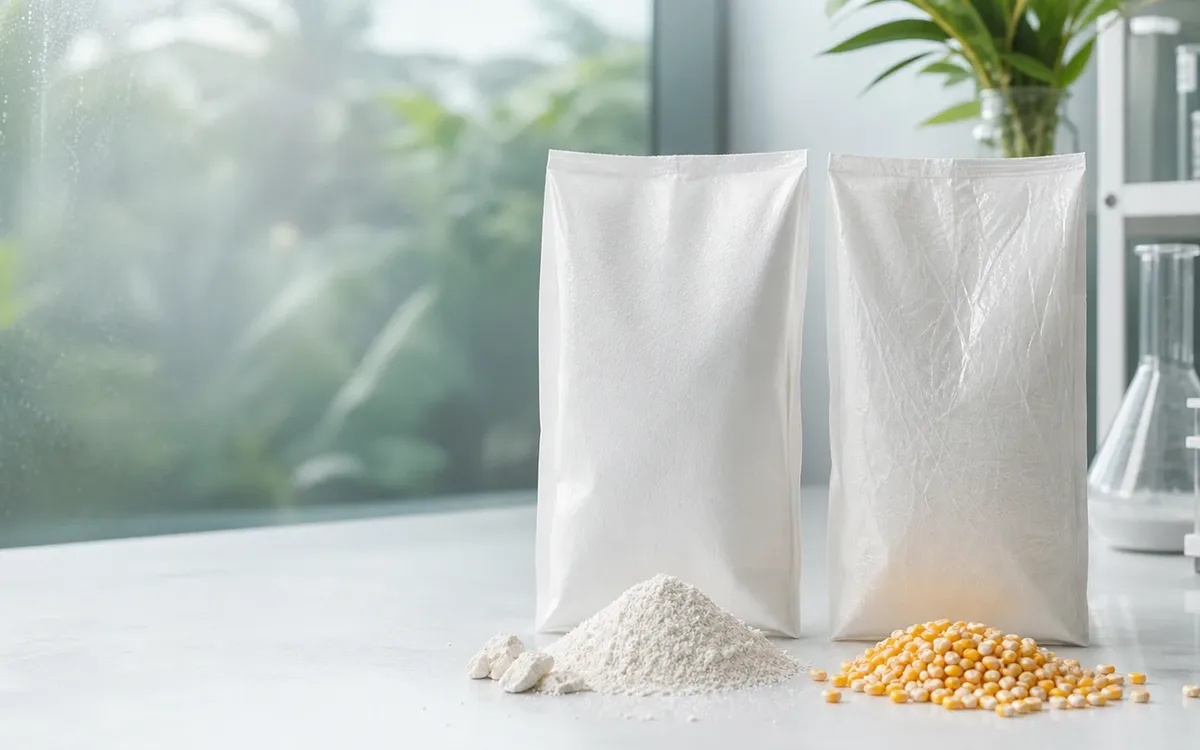
"Compostable bag" covers more than one material system, and the two most common bases — cornstarch (thermoplastic starch, often blended with PBAT) and calcium-carbonate-filled PLA/PBAT — behave differently enough that treating them as interchangeable is a mistake at the sourcing stage.
Cornstarch-based bags
- Built on thermoplastic starch (TPS), usually blended with PBAT to improve flexibility and moisture resistance.
- More moisture-sensitive — starch content can make the film degrade in performance under high humidity storage if not properly formulated and blended.
- Feedstock cost tracks agricultural commodity markets (corn), which introduces a different kind of price volatility than petrochemical resin.
- Can have a slightly higher shrink and lower stiffness at equivalent gauge compared to a calcium-carbonate-filled compound, depending on the starch-to-PBAT ratio.
Calcium-carbonate-filled PLA/PBAT bags
- Built on PLA and PBAT with ground calcium carbonate as a mineral filler, rather than starch as the base polymer.
- More dimensionally stable across a wider range of storage humidity, since the filler is an inert mineral rather than a moisture-absorbing starch.
- Filler cost is tied to mineral supply, not agricultural commodity cycles, which gives procurement a different risk profile than starch-based film.
- Generally holds tensile strength and puncture resistance better at thin gauges, which is why it's the base Zaneco formulated Earthya on for high-volume bag applications.
What doesn't change: certification
Both material bases can be certified compostable — under TÜV Austria OK Compost, BPI, or SIRIM Eco Label — provided the formulation passes the same breakdown-timeframe and zero-residue testing. Certification tells you the end-of-life claim is real; it doesn't tell you how the bag performs on your line or in your customer's hands. That's a formulation question, not a certification one.
Cost and supply-chain considerations
Beyond mechanical performance, the two bases carry different procurement risk profiles. Starch feedstock pricing moves with agricultural cycles — harvest yields, weather, and food-market demand all put pressure on corn pricing independent of anything happening in the plastics industry. Ground calcium carbonate is a mined mineral with a more stable, geographically diversified supply chain, which tends to make cost planning more predictable over a multi-year supply agreement. Neither dependency disappears entirely, but they respond to different shocks — worth factoring in if your sourcing strategy is trying to reduce volatility, not just relocate it.
Which base fits which application
Cornstarch-based film tends to suit lower-throughput, shorter-shelf-life applications where the moisture-management downside is easier to control — think retail carrier bags moved through a supply chain quickly. Calcium-carbonate-filled PLA/PBAT, the base Earthya is formulated on, is built for high-volume applications with longer warehouse dwell time and less controlled storage conditions — garbage bags, singlet bags, and stretch or mulch film, where dimensional consistency across a full production run and shelf life matters more than raw material story.
If you're sourcing compostable bags at volume, ask which base the material is built on and how it was validated for your climate and storage conditions — humidity exposure affects the two material systems differently, and that's the detail that shows up as a complaint after the fact, not before.