
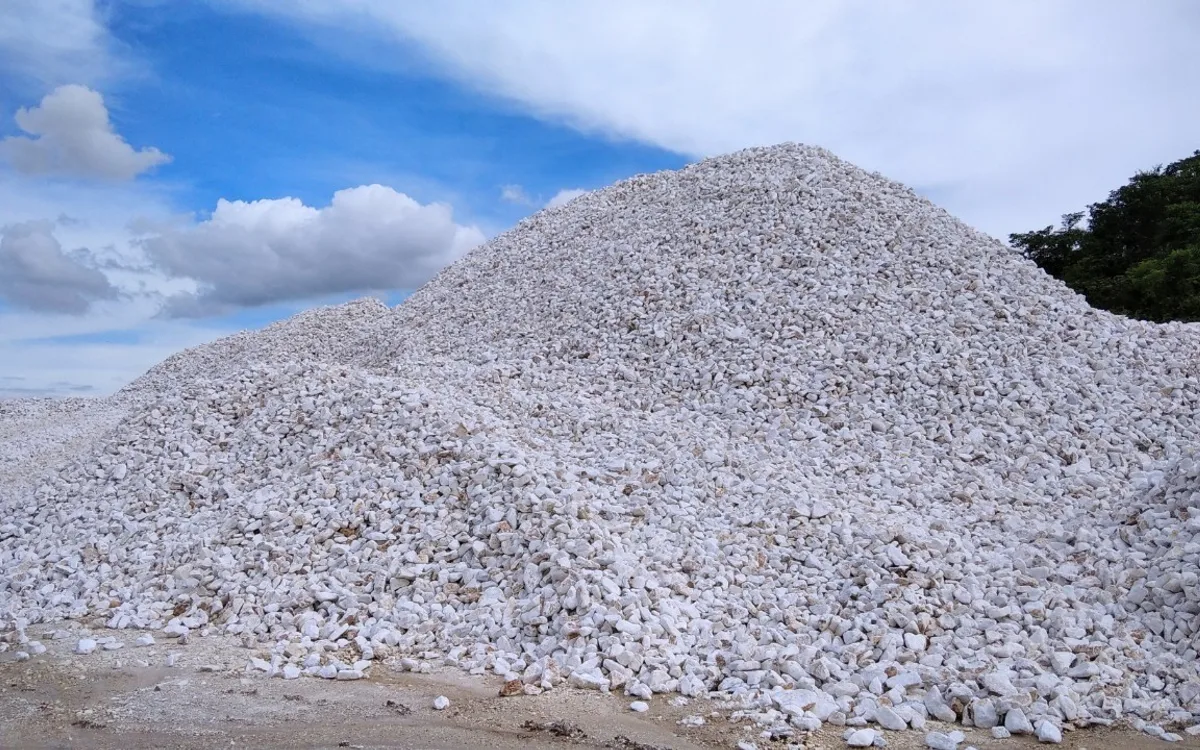
When manufacturers see "calcium carbonate" on a compostable compound's spec sheet, the instinct is to read it as a filler added to cut cost — the same way it's used in some conventional PE and PP film. In a PLA/PBAT compostable compound, calcium carbonate is doing real mechanical and processing work, not just displacing resin volume.
What it actually does in the compound
- Stiffens the film — ground calcium carbonate raises modulus, offsetting the softer, more elastic feel that PLA/PBAT blends have on their own.
- Improves processability on existing lines — it moderates melt viscosity, which is part of what lets the compound run on standard blown- and cast-film equipment without new tooling.
- Stabilises shrinkage and dimensional consistency across a production run, which matters for gauge tolerance on thin film.
- Reduces material cost per kilogram without compromising the compound's certified compostability — the carbonate itself breaks down into harmless mineral residue during composting.
Why it doesn't compromise compostability
Calcium carbonate is a naturally occurring mineral — the same compound found in limestone and eggshells. It doesn't fragment into persistent microplastic-like residue, and it's inert under composting conditions. That's why Earthya, formulated with ground calcium carbonate as part of its PLA/PBAT base, still certifies to TÜV Austria OK Compost, SIRIM Eco Label, and BPI standards: the filler is accounted for in the certification testing, not exempted from it.
The trade-off manufacturers should understand
Loading level matters. Too little calcium carbonate and the film stays too soft and cost-inefficient for high-volume applications; too much and it starts to compromise tensile strength and puncture resistance. Getting that ratio right — for a specific film gauge, application, and line — is exactly what Zaneco's formulation and pilot process is built to validate before a compound ever reaches full production.
How the particle itself affects the outcome
Not all ground calcium carbonate performs the same way in a film compound. Particle size and surface treatment both change how the mineral disperses through the PLA/PBAT matrix during extrusion. Finer, well-dispersed particles integrate cleanly and preserve film clarity and strength at higher loading levels; coarser or poorly dispersed particles create stress points that show up later as pinholes or premature tearing. This is a formulation and process-control detail, not something visible on a datasheet that only lists the filler percentage.
Where Zaneco sources and controls this
Zaneco treats the calcium carbonate grade and loading ratio as part of the formulation itself, not a fixed constant applied across every product. Each compound is validated in-house — melt flow, tensile and impact testing, and thermal analysis — with the filler system tuned to the target application before a formulation moves from lab trial to pilot-scale production. That's the difference between a compound engineered for a specific film gauge and line, and one built to a generic "compostable" spec sheet.
If you're comparing compostable resin suppliers, ask what's in the filler system and how the loading level was validated for your application — not just whether the material is certified compostable in principle.